
AI for Credit Unions: How to Evaluate Platforms Before You Buy
A practical buyer-side evaluation guide for credit union CEOs, COOs, and marketing leaders assessing AI platforms. Covers readiness thresholds, essential vendor criteria (security, compliance, integration, governance), a disqualifier checklist, and a five-step decision framework for comparing finalists.


Credit union leaders hear a version of the same question every quarter: should we be doing something with AI? The honest answer is that it depends on where your institution stands today. AI platforms for credit unions can improve member service, automate routine work, and sharpen fraud detection – but only when the credit union has the operational foundation to use them responsibly. This guide gives you a practical threshold framework to assess your readiness, evaluate vendors on the criteria that matter most (security, compliance, integration, and governance), and spot the disqualifiers before you sign anything.
What "AI for Credit Unions" Actually Means
AI for credit unions refers to human-supervised software that uses machine learning and natural language processing to automate tasks, personalize member experiences, detect fraud, and support credit and risk decisions. The "human-supervised" qualifier matters here. In a regulated financial environment, AI assists staff – it does not replace their judgment on consequential decisions.
Common applications include:
- Conversational AI: Chatbots and virtual assistants that handle balance inquiries, loan-status questions, and appointment scheduling around the clock.
- Fraud detection: Models that flag unusual transaction patterns in real time and route alerts to your team for review.
- Loan decisioning support: AI that scores applications against your underwriting criteria and surfaces relevant member data, with a human making the final call.
- Marketing personalization: Platforms that identify cross-sell and upsell opportunities based on member behavior and life events.
- Operational automation: Document processing, compliance monitoring, and back-office workflows that free staff from repetitive tasks.
The underlying technology ranges from pre-built platforms sold as software-as-a-service to custom models built on your data. Most community credit unions start with SaaS because it requires less internal technical capacity, though the tradeoffs on customization and data control are real.

How to Determine Whether Your Credit Union Is Ready for an AI Platform
The question most CEOs and COOs ask first is really an asset-size question: does AI make sense for a credit union at our scale? Asset size is a reasonable proxy for staff capacity and IT infrastructure, but it is not the deciding factor on its own.
A more useful threshold framework looks at four dimensions:
1. Data Quality and Volume
AI models are only as reliable as the data they train on. Before evaluating any platform, assess whether your core system data is clean, consistently formatted, and large enough to be meaningful. A credit union with fewer than 10,000 members may not generate enough transaction volume for certain fraud or lending models to perform reliably. This is not a disqualifier for AI broadly – it is a signal to prioritize use cases where data volume is less critical, such as member-facing chatbots or document automation.
2. Staff Capacity for Oversight
Deploying AI without someone accountable for reviewing its outputs is how compliance problems start. You do not need a dedicated data science team, but you do need at least one person – a marketing manager, an operations lead, a compliance officer – who owns the AI relationship and monitors results. If your institution is already understaffed to the point where no one can absorb that role, an AI platform will underperform or create risk.
3. Core System Modernity
Most AI platforms integrate with your core banking system via APIs. If your core is older than fifteen years and lacks a published API layer, expect integration to be a significant project rather than a quick connection. This does not make AI impossible, but it raises the cost and timeline materially. Clarify your core system and its API documentation before any vendor conversation.
4. Board and Leadership Alignment
AI decisions that require board approval – technology investments above a threshold, material changes to lending workflows – need a clear internal sponsor. If leadership is skeptical or the board has not yet discussed AI at a governance level, a pilot project tends to land better than an enterprise-wide platform purchase.
Readiness signal: A credit union with clean member data, an accountable internal owner, a modern core system, and leadership alignment is a strong candidate for a commercial AI platform. A credit union missing two or more of these signals should address those gaps before committing to a platform investment.

Essential Vendor Evaluation Criteria: Security, Compliance, Integration, and Governance
Once you have established that your institution is ready to evaluate vendors, the conversation shifts to what separates a credible platform from one that creates risk. Four categories carry the most weight for credit unions.
Security
Credit unions operate under the Gramm-Leach-Bliley Act (GLBA), which requires administrative, technical, and physical safeguards for member data. Vendors who work with credit unions must operate within that framework.
Ask vendors directly:
- Where is member data stored, and what are your data residency policies?
- Do you support data residency restrictions within the United States?
- What encryption standards do you use for data in transit and at rest?
- Do you conduct third-party penetration testing, and how often?
- What is your incident response timeline and notification process?
- Have you completed a SOC 2 Type II audit, and can you provide the report?
A vendor unwilling to produce a SOC 2 Type II report or to clarify data residency policies should not advance past the initial evaluation stage.
Compliance
The National Credit Union Administration (NCUA) has issued guidance indicating that credit unions using third-party AI tools remain responsible for those tools' outputs. Vendor compliance with BSA/AML frameworks, fair lending regulations, and NCUA examination standards is your responsibility to verify – not a condition you can outsource to the vendor.
Ask vendors:
- How does your platform support BSA/AML monitoring and reporting?
- Is your lending or scoring model auditable? Can we produce documentation for an NCUA exam?
- How do you handle model drift, and how frequently are models retrained?
- Do you maintain logs of AI decisions for audit purposes?
- Have you worked with NCUA-supervised institutions before, and do you understand the examination environment?
Integration
Most credit unions run on a core platform from providers like Symitar, Fiserv, or Corelation. The practical integration question is whether the AI vendor has an existing, maintained connector for your specific core – or whether they are promising to build one.
Ask vendors:
- Which core banking systems do you currently integrate with, and at what depth?
- Does your integration require real-time API access, batch file transfers, or both?
- Who manages the integration during implementation, and who owns ongoing maintenance?
- What happens to the integration if our core provider releases a major update?
- What is the realistic implementation timeline for our core system?
Data residency within integrations: Understand whether member data leaves your core, where it goes, and how long the vendor retains it. Some platforms process data in shared cloud environments; others offer dedicated tenancy. For credit unions with strict data residency requirements, this distinction matters more than most vendors make clear during sales conversations.
Model Governance
Governance is the category most credit unions overlook during vendor evaluation and regret during examination prep. A model governance framework describes how an AI platform's decisions are monitored, documented, tested for bias, and corrected when they drift.
Ask vendors:
- Do you provide model cards or documentation describing how each model was built and validated?
- How do you test models for disparate impact under fair lending standards?
- What is your process for model updates, and how are credit unions notified?
- Can your platform produce explainability outputs – reasons behind decisions – for member-facing applications?
- Who at your organization is accountable for model performance?

Disqualifiers: When to Walk Away
Structure this as a checklist before any vendor advances to a demo or a contract review.
Disqualify a vendor if any of the following are true:
- The vendor cannot produce a current SOC 2 Type II audit report when asked.
- The vendor cannot clearly state where member data is stored or processed.
- The vendor's data processing agreement requires you to waive GLBA-related data protections.
- The vendor cannot demonstrate a working integration with your core banking system – not a roadmap, not a partnership letter.
- The vendor's model is a black box with no explainability layer and no audit trail.
- The vendor has no process for handling model drift or retraining, and no timeline for model updates.
- The vendor cannot explain how their models have been tested for disparate impact under the Equal Credit Opportunity Act or the Fair Housing Act.
- The vendor's contract grants them rights to use your member data to train models that benefit other customers.
- The vendor has no reference customers in the credit union or community banking space.
- The vendor cannot name a specific point of contact who understands NCUA examination requirements.
Walk away from any of these. Each represents a category of risk – regulatory, operational, or legal – that is disproportionate to whatever efficiency the platform might deliver.
A Decision Framework for Comparing AI Platforms
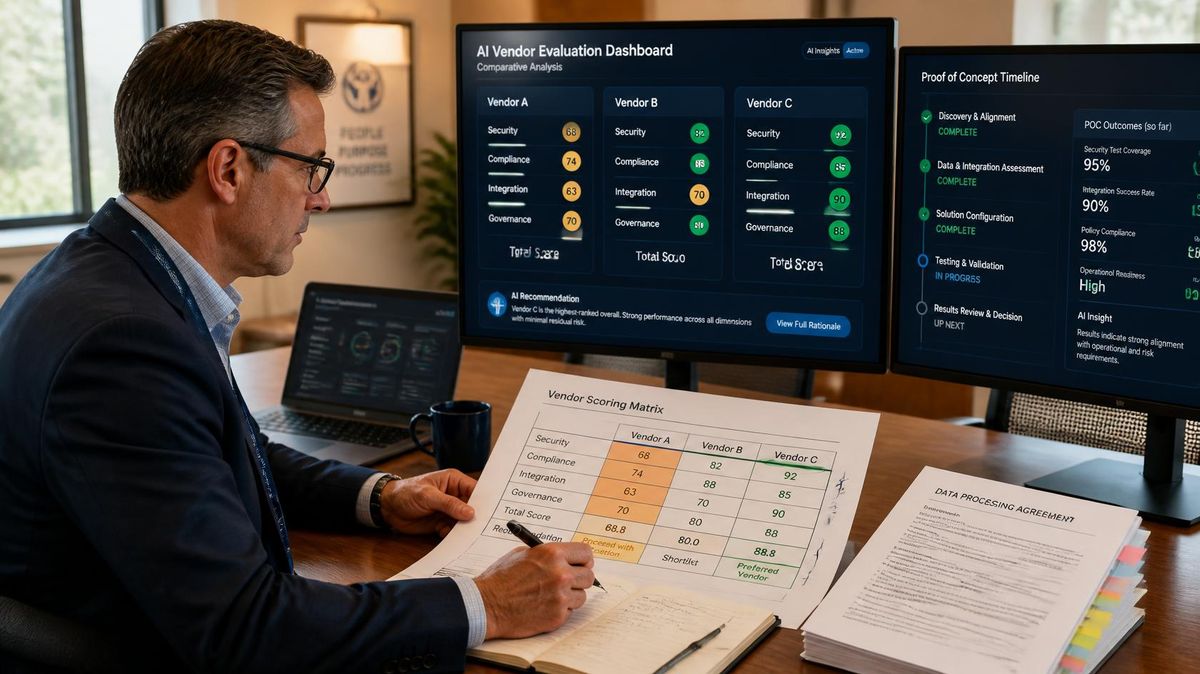
Once you have screened vendors against the disqualifiers above, the comparison phase benefits from a structured approach. A scoring rubric forces discipline in conversations where sales momentum can otherwise substitute for rigor.
Step 1: Define Your Use-Case Priority
Before vendor conversations begin, rank the use cases your institution wants to address in the next twelve months. Fraud detection, member service automation, and marketing personalization are the most common starting points for credit unions. Prioritizing use cases first prevents vendors from reordering your priorities around their product strengths.
Step 2: Map Vendors to Your Core System
Confirm in writing that the vendor has a live, maintained integration with your specific core banking platform. Request the names of at least two reference credit unions running that integration today. Contact them.
Step 3: Score Each Vendor on a Standard Rubric
Use a consistent scoring matrix across all finalists. Categories worth scoring include:
Weights can shift based on your institution's priorities, but security and compliance together should account for at least 45 percent of the total score for any credit union operating in an NCUA-examined environment
Step 4: Run a Structured Proof of Concept
For finalists, require a time-boxed proof of concept – typically 30 to 90 days – using your actual data in a sandboxed environment. Define success metrics before the POC begins. Measure against them, not against vendor-supplied benchmarks. A vendor resistant to a structured POC with defined exit criteria is telling you something important.
Step 5: Legal and Compliance Review Before Signing
Have your compliance team or outside counsel review the vendor agreement, the data processing addendum, and the AI model documentation before signing. Pay particular attention to data rights provisions, indemnification language, and audit rights. Many standard SaaS agreements are written for general commercial use and require modification for financial services.
Common Mistakes Credit Unions Make When Evaluating AI Platforms
Even well-run institutions make a predictable set of errors in vendor evaluation. The most common:
Starting with a demo instead of a readiness assessment. A well-produced demo creates enthusiasm before the hard questions get asked. Start with a written RFI that requires vendors to answer your security, compliance, and integration questions in writing before any demonstration.
Treating AI as an IT decision rather than an institutional one. AI platforms that touch lending decisions, member communications, or fraud workflows affect compliance, member relations, and governance. The evaluation team needs representation from compliance, operations, and leadership – not just IT.
Prioritizing price in the first conversation. Price is a fair consideration, but it should follow use-case fit, security review, and integration confirmation. A platform that fails an NCUA examination costs far more than the savings from a lower monthly subscription.
Accepting vendor-supplied ROI projections. A vendor's ROI model is built to close a sale. Request the methodology, the assumptions, and reference customers you can call. Build your own projection using your institution's actual data on staff time, member volume, and cost per interaction.
Skipping the exit terms. What happens to your data if you end the contract? How long does the vendor retain it? Can you export your member interaction history and model configurations? These terms are negotiable before signing and nearly impossible to improve after the relationship is established.
How Human-Supervised AI Fits Into This Decision
One consideration worth raising with any AI vendor is the difference between a self-service platform and a managed, human-supervised deployment. A self-service platform gives your team software tools and expects you to configure, monitor, and optimize the AI on your own. A human-supervised model – where trained specialists review AI outputs before they reach members or the public – provides an additional layer of oversight that can be particularly valuable for credit unions that lack internal AI expertise.
[INTERNAL LINK OPPORTUNITY: ProElevate credit union services page – AI solutions for credit unions]
Neither model is right for every institution. The right choice depends on your internal capacity, your appetite for oversight responsibility, and the use cases you are prioritizing. What matters most is that the oversight model is explicit – that someone, internal or external, is accountable for what the AI produces.
Frequently Asked Questions
At what asset size does an AI platform make sense for a credit union?
Asset size alone does not determine readiness. Credit unions with as few as $50 million in assets have deployed AI successfully in limited use cases such as member-facing chatbots. Larger institutions typically have the data volume and staff capacity to support broader deployments. The more useful question is whether you have clean data, an accountable internal owner, a modern core system, and leadership alignment – regardless of balance sheet size.
Who is responsible for AI compliance at a credit union?
The NCUA has been clear that credit unions using third-party AI tools remain responsible for those tools' outputs. Regulatory accountability cannot be contracted away to a vendor. Your compliance team owns the obligation to verify that any AI application meets fair lending, BSA/AML, and data security requirements, and that the vendor's documentation supports your examination posture.
What is a SOC 2 Type II audit, and why does it matter for AI vendors?
A SOC 2 Type II audit is an independent third-party examination of a technology vendor's security, availability, and data-handling controls over a defined period – typically six to twelve months. A Type II report provides evidence of how controls actually performed, not just how they were designed. For credit unions, a vendor's willingness to produce a current SOC 2 Type II report is a basic threshold for data-handling credibility.
What is model governance, and why should credit unions care?
Model governance is the set of policies and processes a vendor uses to monitor, document, test, and update its AI models over time. For credit unions, it matters because AI models can drift – their accuracy can degrade as member behavior changes – and because models used in lending or member communications must meet fair lending standards. A vendor with no formal governance process is a regulatory and reputational exposure.
How long does it typically take to implement an AI platform at a credit union?
Implementation timelines vary significantly by platform and use case. Member-facing chatbot deployments may go live in 60 to 90 days with a modern core system integration. More complex deployments involving lending decisioning or back-office automation can take six months or longer. Any vendor promising a one-week deployment for a core-integrated, compliance-sensitive application should be asked to explain what they are skipping.
Can a credit union use AI platforms without a dedicated IT team?
Yes, though with conditions. Cloud-based AI platforms require less internal technical infrastructure than on-premise solutions, and managed service providers can absorb configuration and monitoring responsibilities. What a credit union still needs internally is someone accountable for reviewing outputs, escalating issues, and owning the vendor relationship. The technical lift can be outsourced; the institutional accountability cannot.
Conclusion
Evaluating AI platforms for credit unions is not primarily a technology decision – it is a governance and risk decision that happens to involve technology. The credit unions that get the most value from AI are the ones that assess their readiness honestly, ask vendors the hard questions in writing before any demo, and maintain clear internal accountability for what the AI produces.
If your institution is in the early stages of this evaluation, the most useful next step is an honest assessment of where you stand on data quality, staff capacity, core system readiness, and leadership alignment. From there, the vendor conversation has a foundation.
ProElevate works with credit unions and community banks at exactly this stage. Our AI-readiness assessment identifies where your institution stands on data quality, staff capacity, core system readiness, and leadership alignment – so you know what to address before any platform investment, not after. We also deploy and manage human-supervised AI agents for credit unions that are ready to move: marketing automation, member onboarding, content, and local AI visibility, all reviewed by a trained person on our team before anything reaches your members or the public. Book a demo to see how ProElevate supports credit unions through the evaluation process and beyond – and to learn what the assessment typically surfaces for institutions at your stage.


