
Credit Union Marketing: The 2026 Playbook for Member and Deposit Growth
A 2026 credit union marketing playbook for lean teams: channel allocation, compliance workflows, and measurement tied to deposits and net new members.


Effective credit union marketing in 2026 begins with a structural reality most marketing directors know well: a mandate that spans the entire member lifecycle, a team of one to five people to execute it, a budget that competes with branch operations every cycle, and a compliance review requirement on every asset before it reaches a member.
That gap – large mandate, lean team, shared budget, gated production – is where credit union marketing strategy holds together or falls apart. This playbook covers the territory end to end: how the function is structured, how each stage of the member lifecycle maps to repeatable work, how to allocate channels and defend a budget at the board level, how to keep compliance from stalling production, and how to measure against the outcomes that matter – deposits, net new members, and products per member.
How Credit Union Marketing Is Actually Structured
At most credit unions under a billion dollars in assets, the organizational model is simple: one to three marketing staff, a shared services budget, and a dotted line to the compliance officer. The marketing director owns strategy, production, and reporting simultaneously. The structure reflects how credit unions are built – member-owned, cost-conscious institutions where every dollar in overhead competes with the rate advantage passed back to members.
The problem is the gap between what the structure can produce and what member acquisition and retention require. A team of two carrying the full lifecycle will always face a queue. Campaign production and compliance review consume the calendar. The strategic work – lifecycle mapping, channel testing, annual planning – falls to the bottom.
Three structural choices close that gap before any channel strategy is built. First, separate the roles of strategist and producer: even on a two-person team, one person should own the editorial calendar and plan while the other manages production. When both split production equally, neither has headroom to think structurally. Second, establish a fixed marketing budget line. A budget re-adjudicated every quarter cannot support a twelve-month plan; boards respond to a standing allocation tied to growth targets when the case is made before the budget cycle, not during it. Third, formalize the compliance review relationship: a standing weekly review slot, a pre-approved content library, and a tiered review protocol convert an unpredictable bottleneck into a predictable schedule.

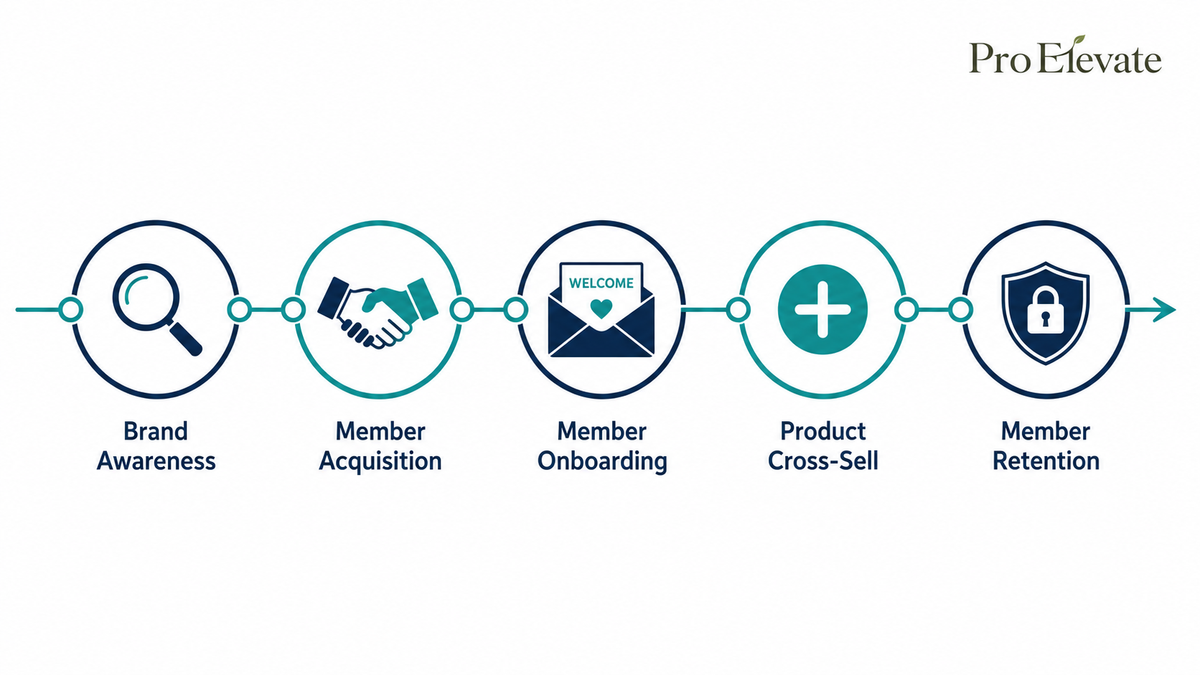
The Member Lifecycle, From Awareness to Retention
Credit union marketing works best when it follows the member's actual path: from first awareness through years of deepening relationship. Each stage has different goals, different channels, and different metrics.
Awareness: Getting Found Before the Decision
Awareness work happens before a person has any intention to switch financial institutions. The most significant shift over the past year is AI search: when someone asks a voice assistant or chat interface where to get an auto loan or which local institution has the best CD rates, the answer is a synthesized recommendation drawn from your digital presence, not a list of paid results. At United Texas Bank, 20% of new leads now come through ChatGPT and Grok – a channel that did not exist in their pipeline a year ago. (Source: United Texas Bank.) Showing up in both traditional local search and AI-generated answers requires complete, current, and locally relevant content on your website.
Acquisition: Converting Awareness Into Applications
Paid search, display retargeting, and geo-targeted social campaigns do most of the acquisition work for credit unions with digital-first prospecting budgets. For those with deeper community roots, employer partnerships and field-of-membership campaigns move the same needle. The critical asset at this stage is the product landing page. Most credit union websites describe what a product is without making a compelling case for why the rate, terms, or member relationship makes it the right choice. Fixing the product page – rate transparency, a clear application path, member testimonials that comply with Reg Z and FFIEC guidance – often returns more than adding a new acquisition channel.
Onboarding, Cross-Sell, and Retention
The first 90 days are the highest-leverage period in the entire member relationship. Members who use more than one product within the first year are significantly more likely to remain over a five-year window. Most onboarding programs consist of a single welcome packet and a direct deposit prompt – not enough. An effective sequence delivers short, product-relevant communications timed to common milestones: the first statement, the first digital banking login, week six for an auto or savings product prompt based on account data.
Getting a member from one product to two is the most efficient growth lever available. The second-product prompt should come from data: a member with a checking account and direct deposit who has not opened savings is a natural target for an emergency fund campaign. A library of pre-approved templates for each second-product scenario eliminates the per-campaign review bottleneck on your highest-frequency outreach.
Member attrition is largely silent. Members rarely close accounts – they let them go dormant. The checking account that stops seeing direct deposit activity, the savings account that has not moved in six months: these are early warning signals. A dormancy alert sequence, triggered by inactivity patterns in the core system, lets the marketing team reach disengaging members before they are gone.
Channel Allocation and a Budget Model That Survives Board Scrutiny
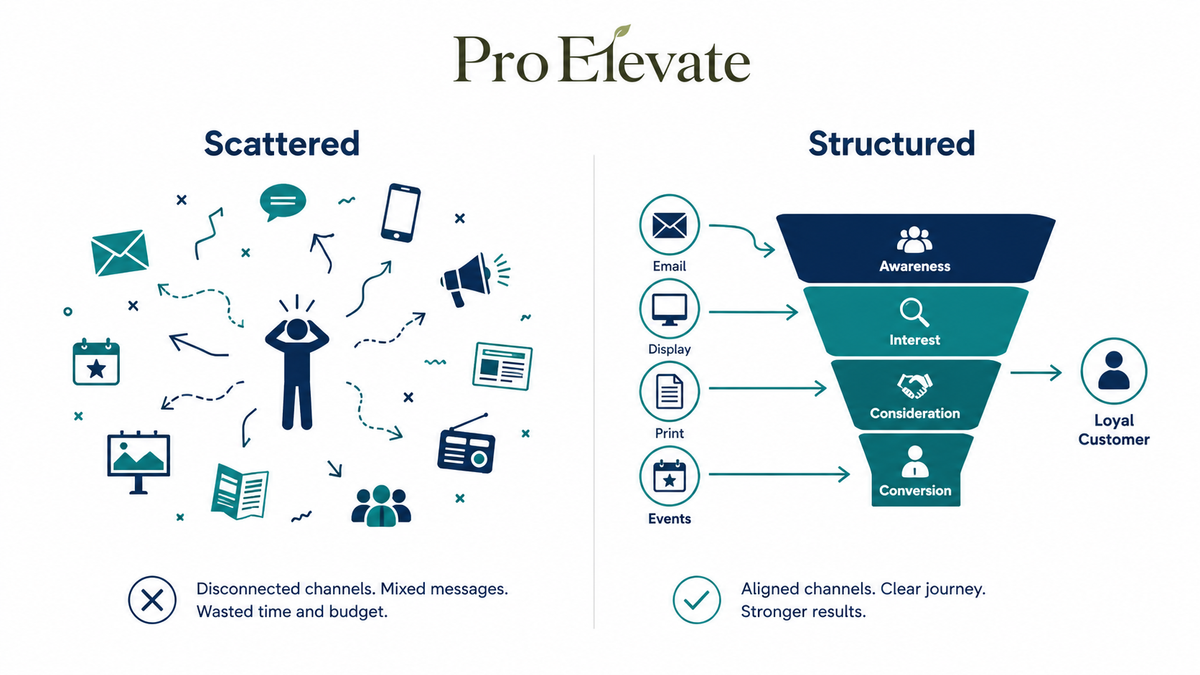
Channel allocation for a small credit union marketing team is a triage problem. No team of two or three can actively manage more than four or five channels well. The question is which channels to prioritize and how to defend that allocation when branch and lending leadership want the same budget dollars.
A Practical Starting Allocation
For a credit union with a marketing budget between 0.05% and 0.10% of assets – a common range for institutions under $500M – a workable channel allocation looks roughly like this.
Local search and digital presence (25–30%). Google Business Profile, local SEO, and AI-visibility content. This is the foundation. A prospective member who searches for a mortgage lender nearby or asks an AI assistant for CD rate comparisons has to find you before any other channel matters.
Paid digital acquisition (25–30%). Paid search, display retargeting, and geo-targeted social for product-specific campaigns. Tied directly to applications and funded product openings, which makes it easier to defend at the board level than brand-awareness spend.
Email and lifecycle automation (15–20%). Onboarding sequences, cross-sell triggers, renewal reminders, and dormancy alerts. Once the content library and trigger logic are built, this channel runs continuously at low incremental cost.
Community and field-of-membership marketing (15–20%). Employer partnerships, community events, co-branded campaigns with local businesses, SEG outreach. These channels are harder to measure directly but maintain the field-of-membership advantage that distinguishes credit unions from banks.
Content and thought leadership (5–10%). Blog, resource library, educational content. Primarily supports local SEO and positions the credit union as the knowledgeable local option. Feeds the AI search channel over time.
Boards approve marketing budgets based on one question: what does the credit union get for this spend? The most effective justification ties spend directly to outcomes the board already tracks. Take the prior year's new member acquisition numbers, calculate the average deposit value of a new member in year one, and compare that figure against cost-per-acquisition from each channel. A channel-by-channel ROI model, even an approximated one, shifts the conversation from how much are we spending to are we allocating optimally.
A Compliance Review Workflow That Does Not Stall Production
Compliance review is not optional in credit union marketing. Every consumer-facing communication is subject to NCUA advertising rules, Regulation Z for credit products, Regulation DD for deposit products, fair lending standards, and state-specific requirements. The question is not whether to have a review process but how to build one that does not turn a one-week campaign into a three-week campaign.
Tiered review by content type. Not every asset carries the same regulatory risk. A rate table with mandated disclosures carries high risk. A social post with no rate references and no offer language carries low risk. A tiered review protocol – where the compliance officer reviews rate-based communications in full but templated social content goes through a checklist-based fast-track – cuts review time on lower-risk content significantly without reducing compliance coverage where it matters.
The pre-approved content library. Most credit union marketing programs run the same campaign types every year: auto loan promotion in spring, back-to-school savings in August, holiday loan and CD specials in Q4. Building a library of pre-approved templates for each recurring campaign type means that execution requires only a rate insertion review, not a full creative review. A library of twenty pre-approved templates can support the majority of a credit union's annual marketing calendar.
The standing review slot. A weekly 30-minute slot on the compliance officer's calendar, reserved for marketing review, converts an ad hoc request queue into a predictable schedule. Marketing plans production around the review slot. Compliance knows when to expect submissions. Assets that miss the weekly slot go to the next week – which creates a natural deadline structure for the production team.

Measurement: Deposits, Net New Members, and Products Per Member
Marketing measurement at a credit union should connect to the same metrics the board and CEO use to evaluate institutional health. Impressions, clicks, and open rates are useful operational signals, but they do not belong in a board report and they do not confirm whether marketing activity is driving growth.
Net new members. The difference between members joined and members attrited in a given period. Marketing should be able to trace how many new members came through each acquisition channel – paid search, referral, employer partnership, organic search – so that budget allocation can follow what works.
Funded deposits from new members. Not all new members bring the same deposit value. Tracking funded deposit value by acquisition cohort tells the marketing team which campaigns attract the members the institution actually wants.
Products per member. The average number of products held by active members, tracked by onboarding cohort. Rising products per member in the first-year cohort confirms that the onboarding and cross-sell sequences are working.
Keep the board report to three or four outcomes. Most core systems – including those running on Jack Henry, Fiserv, and Symitar – can produce the membership, deposit, and product data needed to build this reporting model. Even a manual monthly reconciliation, pulling campaign-source data from the CRM or ad platform and matching it against new account data from the core, gives enough to build a directional model the board trusts.
When to Bring In Outside Help
Keep in-house anything requiring institutional knowledge or compliance judgment: member relationship understanding, community brand decisions, and core system access. Bring outside capacity to execution tasks that consume calendar without requiring that knowledge: production volume, paid media trafficking, AI and technology implementation, SEO and digital presence management, and content production for pre-approved content types.
When evaluating any outside vendor, three questions determine fit for a compliance-governed institution: Do they understand regulated financial services marketing – or will they create compliance problems you then have to fix? Do they show you work before it ships, with client approval required before anything reaches a member? Do they work within your existing systems rather than requiring migration? For credit unions evaluating AI-assisted support, explore how ProElevate works with credit unions.
Common Mistakes That Stall Credit Union Marketing Programs
Running campaigns without a lifecycle framework. A campaign that drives awareness or applications without a corresponding onboarding sequence loses most of its value. Build the lifecycle before you scale the campaign.
Measuring marketing in the wrong language. When the board asks about marketing results and the answer is impression counts and click-through rates, the marketing function loses credibility. The board is asking about members and deposits. Lead with those numbers.
Letting compliance become a veto rather than a process. When compliance review is ad hoc, reactive, and underscheduled, it functions as a bottleneck that kills initiative. When it is structured, scheduled, and tiered, it functions as a quality control process that makes campaigns better and faster.
Spreading the budget across too many channels. A small marketing team with a limited budget cannot maintain seven channels at adequate quality. Better to be excellent at three or four and cut the rest.
Skipping AI search visibility. A credit union whose website does not answer common local financial questions will not appear in AI-generated recommendations, regardless of paid search investment. Content that answers these questions explicitly is now a basic requirement for local digital visibility.
Practical Next Steps for Credit Union Marketing Directors
- Audit the lifecycle, not the channels. Before changing any campaign, map what currently exists at each lifecycle stage and identify where there is no communication at all.
- Set the three measurement outcomes. Agree with your CEO on the metrics that will define success for the next twelve months – net new members, funded deposits from new members, and products per member in the first-year cohort.
- Design the compliance workflow before the next campaign. Propose a tiered review protocol and a standing weekly review slot, and get the fast-track content types approved before production begins.
- Audit your AI search presence. Search your credit union's primary product types in ChatGPT, Perplexity, and Google AI Overviews and note whether you appear in local financial services recommendations.
- Identify one area to bring in outside capacity. Find the one execution area that consumes the most calendar time for the least strategic value – that is the first area to scope for outside support.
How Supervised AI Helps a Lean Credit Union Marketing Team
The production constraint for a lean credit union marketing team is not creativity or strategic judgment. It is throughput: the number of assets the team can research, draft, review, and ship in a given month. A two-person team managing a full member lifecycle and an active compliance review process has a natural ceiling. Supervised AI lifts that ceiling.
The key word is supervised. In a regulated marketing environment, AI content that goes out without human review is a compliance risk. The model that works for credit unions: AI handles research and drafting, a trained specialist reviews the output, and the credit union retains final approval before anything reaches a member. ProElevate operates this way – agents draft and stage work, a trained specialist reviews every output before it reaches the client's approval queue, and nothing goes to a member or the public until the credit union approves it. Client data stays in the client's own systems, encrypted in transit and at rest, with every agent action logged. Full detail on ProElevate's security and data handling practices. For credit unions on Jack Henry, Fiserv, or Symitar, ProElevate works within those existing environments – no migration, no rip-and-replace.

Frequently Asked Questions
What is credit union marketing, and how is it different from bank marketing?
Credit union marketing covers all the activities a credit union uses to attract new members, deepen existing member relationships, and retain members over time. The core difference from bank marketing is the field-of-membership constraint: credit unions can only market to people who are eligible to join based on geography, employer, association, or other qualifying factors. That constraint shapes channel selection, messaging, and community strategy in ways that do not apply to banks with open membership.
How much should a credit union spend on marketing?
Industry benchmarks for credit unions under $500M in assets typically range from 0.05% to 0.10% of total assets annually. The more useful framing is cost-per-funded-account: what does it cost to acquire a member who funds a deposit or loan relationship? That figure, compared against the lifetime deposit value of a member, tells you whether the marketing investment is justified.
What are the most effective channels for credit union member acquisition?
Paid search, local SEO, and AI search visibility are the highest-leverage acquisition channels for most credit unions in 2026, because they capture prospective members at the moment of an active financial need. Email lifecycle sequences are the highest-ROI channel for deepening existing member relationships. Community and employer-partnership channels are most effective for maintaining field-of-membership brand awareness among prospects not yet in active search mode.
Conclusion: Credit Union Marketing Built for the Actual Constraints
Credit union marketing in 2026 works when it is designed around real operating conditions: a lean team, a shared budget, a compliance process on every asset, and outcomes measured in members and deposits rather than impressions.
The credit unions gaining ground against larger institutions are not the ones with bigger budgets. They are the ones with cleaner lifecycle structures, more disciplined channel allocation, better compliance workflows, and measurement systems that connect marketing activity to funded accounts. Those are structural advantages, not spending advantages.
If you are a marketing director or growth lead evaluating how to close the gap between your current output and what member and deposit growth actually requires, explore how ProElevate supports credit union marketing teams – or book a call to see the work firsthand.


