
What AI Agents Can Actually Do for a Credit Union or Community Bank
Learn how AI agents help credit unions and community banks manage local search, onboarding emails, loan campaigns, and follow-ups with human oversight.


What AI Agents Can Actually Do for a Credit Union or Community Bank
Artificial intelligence is creating new opportunities for credit unions and community banks, but understanding what it can realistically accomplish is essential before adopting it. For institutions with small marketing and operations teams, the biggest opportunity may be using AI to manage repetitive work that often gets delayed because employees have too many competing responsibilities.
An AI agent is a software system that uses artificial intelligence to work toward a defined goal, perform tasks, and respond to information within established permissions and rules. For a two-to-five-person marketing and operations team, AI agents can help prepare local search updates, draft member onboarding emails, organize loan campaigns, and flag follow-ups that need attention. Depending on their integrations and permissions, they can also coordinate approved workflow steps while employees retain control over review and publication.
The goal is not to replace employees or automate every interaction. It is to help teams complete important work more consistently while maintaining accuracy, security, and accountability.
What Are AI Agents, and How Do They Work in Banking?
AI agents are designed to do more than generate a response to a single prompt. Depending on their capabilities, they can work toward a defined objective, use approved information, complete a sequence of tasks, and determine what action to take next within a configured workflow.
Traditional automation usually follows predetermined rules. For example, an email platform may send a welcome message whenever someone completes an account-opening process. An AI agent may be able to prepare a sequence of onboarding emails, summarize the information needed for each message, identify missing details, and organize the content for review.
The difference is flexibility. Rule-based automation follows predefined conditions, while an AI agent may be able to interpret information and adapt its next step within established boundaries.
However, not every tool described as an AI agent has the same capabilities. Some systems only generate content or recommendations. Others can interact with connected applications, organize tasks, or execute approved actions. The actual capabilities depend on the product, its integrations, the quality of its information, and the permissions it receives.
For credit unions and community banks, AI agents can support marketing and administrative workflows without requiring employees to surrender control over important decisions. Their value depends on selecting appropriate tasks and defining clear boundaries for what the system can and cannot do.
Where AI Agents Can Help With the Work That Never Gets Done
Small marketing and operations teams often have more responsibilities than available time. Maintaining website content, preparing campaigns, responding to recurring requests, and tracking follow-ups can leave little room for proactive marketing.
As a result, important work may remain unfinished even when the team understands its value. AI agents can help reduce this backlog by preparing content, organizing information, identifying outstanding tasks, and moving approved work through a defined process.
1. Maintaining Local Search Visibility

Local search helps prospective members discover nearby credit unions and community banks when they search for financial services, branches, checking accounts, savings products, or loan options.
Maintaining local visibility requires regular attention to website pages, business listings, branch information, service descriptions, and frequently asked questions. For a small team, these updates can easily become secondary priorities.
AI agents can help identify outdated website content, prepare location-specific drafts, organize recurring optimization tasks, and flag inconsistencies in information available from approved sources. If connected to the appropriate tools, an agent may also help coordinate updates across a defined workflow.
For example, when a community bank opens a new branch, the marketing team may need to update its location page, branch hours, service descriptions, and supporting announcements. An AI agent could prepare a list of required updates and draft the relevant content for an employee to review.
Human review remains essential. Branch locations, contact information, operating hours, product availability, and financial details must be verified before publication. An agent should not independently invent information or publish unverified claims.
The objective is to make local search maintenance more consistent and manageable, not to generate large volumes of generic content. Accurate, useful information should remain the priority.
2. Preparing Member Onboarding Emails

The member experience does not end when an account is opened. New members may need information about digital banking, account features, available services, security practices, and how to contact the institution for assistance.
Preparing a clear onboarding sequence takes time. Marketing and operations employees must coordinate information, write messages, verify details, and ensure that communications reflect the institution's actual processes.
AI agents can help prepare this work. They can draft welcome emails, organize messages by onboarding stage, adapt approved content for different account types, and identify missing information before a sequence moves to review.
For example, a credit union could use an AI agent to prepare a welcome email, a follow-up explaining digital banking features, and a message directing new members to approved support resources. The marketing team would then verify the details and confirm that the sequence reflects the credit union's actual services and procedures.
If the agent is connected to an email marketing platform, it may also help prepare the sequence for scheduling. Automatic sending should only be enabled when the institution has approved the workflow, validated the audience and triggers, and established appropriate privacy and communication controls.
AI should not invent account benefits, make promises about approvals, or provide personalized financial guidance without suitable safeguards. The priority is to make onboarding communications clearer and easier to manage while preserving accuracy and trust.
3. Organizing Loan Campaigns

Loan campaigns involve several connected activities. A team may need to prepare website content, draft emails, create social media posts, organize publication dates, and ensure that every asset reflects approved product information.
These tasks can become difficult to manage when the same employees are also responsible for member communications, reporting, and day-to-day operations.
AI agents can help turn an approved campaign brief into an organized set of marketing materials. Depending on the system, an agent may draft a landing page, suggest social media copy, prepare an email outline, create a content calendar, and identify details that require confirmation.
Consider a credit union promoting an auto loan. An AI agent could prepare an educational article about the application process, draft a campaign email using approved product information, and organize supporting social posts. Employees would review the materials and verify the interest rate, eligibility requirements, disclosures, application details, and any applicable offer conditions before publication.
This is particularly important in financial services. A polished message can still contain inaccurate or misleading information. AI-generated content should never be treated as authoritative simply because it sounds convincing.
The agent can help prepare the campaign and reduce repetitive work. The credit union remains responsible for ensuring that its marketing is accurate, appropriate, and approved.
4. Keeping Renewal and Follow-Up Tasks on Track
Recurring follow-ups are another area where important work can be missed. Depending on the institution's processes, employees may need to track expiring offers, scheduled reviews, outstanding documents, business banking inquiries, or other requests that require timely attention.
AI agents can help organize these workflows by identifying upcoming tasks from authorized data sources, preparing reminder drafts, summarizing outstanding actions, and flagging items that appear overdue. With appropriate integrations and permissions, they may also route tasks to the responsible employee.
For example, if a community bank has an approved process for following up on a business banking inquiry, an agent could prepare a reminder and summarize the previous interaction for the assigned employee. That employee could review the context and decide on the appropriate response.
The agent should not assume that every outstanding task requires the same action. A request may already have been resolved, a member may have responded, or a situation may require specialist attention.
Reliable workflows therefore need clear rules for exceptions, escalation, and correction. Employees must be able to intervene when the available information is incomplete or the situation requires judgment.
The goal is to reduce avoidable administrative gaps while ensuring that important member interactions remain relevant and timely.
What AI Agents Should Not Handle Independently
Understanding the limits of AI agents is just as important as identifying their potential benefits.
AI agents should not independently make lending or credit decisions, change account permissions, transfer funds, bypass identity verification, or provide binding financial or legal advice. They should not promise loan approval, invent product terms, or send sensitive communications without the appropriate authorization and safeguards.
They should also not receive unrestricted access to member information simply because a workflow would be easier to automate. Access should be limited to what the task requires, with data handled according to the institution's privacy, security, and retention requirements.
AI-generated content can contain inaccurate details, omit important context, or produce statements that sound confident but are unsupported. Financial institutions need processes for identifying these errors before they affect members.
The National Credit Union Administration (NCUA) provides resources on AI-related considerations for credit unions, including privacy, risk management, vendor oversight, and security. Existing legal and regulatory responsibilities do not disappear when a financial institution adopts AI.
For executives, the key question is not simply whether an agent can perform an action. It is whether that action is appropriate, authorized, monitored, and supported by a reliable process.
Who Reviews AI Output and Approves Publication?
Human oversight should be part of the workflow from the beginning, not an informal check added after the AI agent has completed its work.
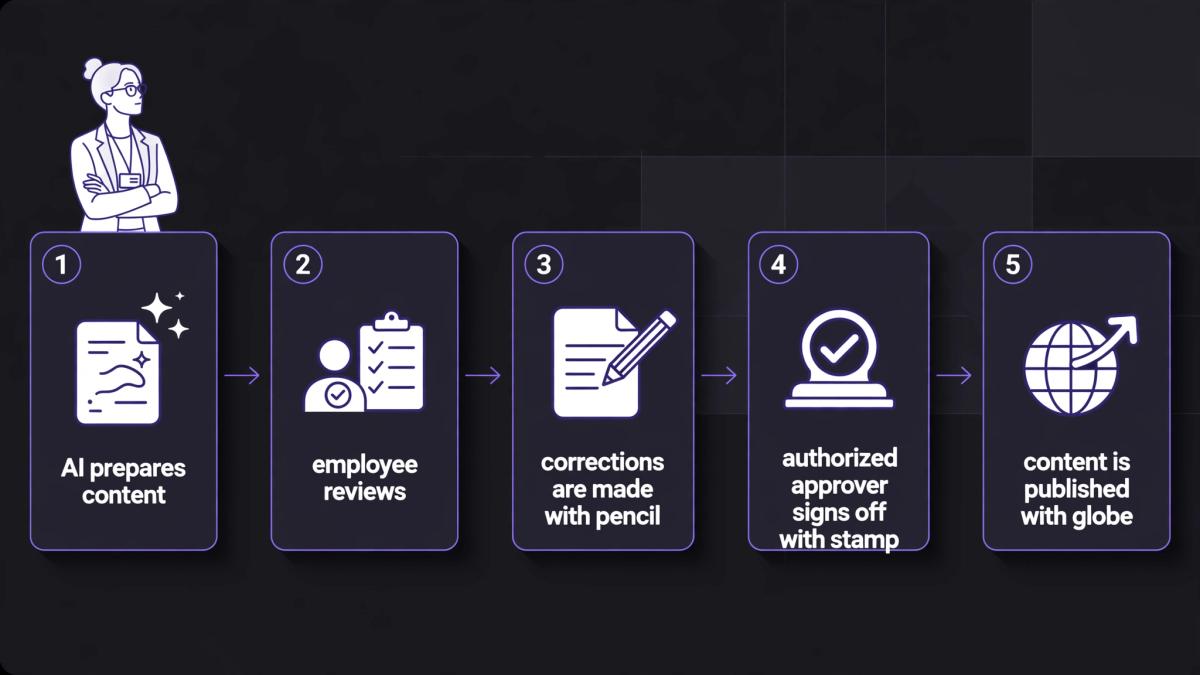
A practical process separates preparation, review, and approval.
The AI agent prepares the work. It may organize a campaign brief, draft an email, identify missing information, or assemble content for a local search update using approved sources and instructions.
The responsible marketing or operations employee reviews the output. This person checks accuracy, tone, relevance, links, audience, and consistency with the institution's approved information. Unsupported claims, incorrect product details, or inappropriate statements must be corrected before the work proceeds.
The designated approver authorizes publication or sending. Depending on the communication and the institution's policies, this may be a marketing manager, product owner, compliance reviewer, or another authorized employee. Higher-risk communications may require additional review.
The institution monitors the workflow. Teams should maintain appropriate approval records, restrict permissions, review errors, and establish a process for pausing or reversing automated actions where possible.
Not every task needs the same level of review. An internal summary may require a different process from a loan promotion or a message containing member-specific information. Approval requirements should reflect the risks involved.
ProElevate's human-supervised approach emphasizes the distinction between AI-assisted execution and human accountability. AI can help prepare and organize recurring marketing work, while people retain control over what is approved and published.
Security Questions to Ask Before Adopting AI Agents
For a credit union or community bank, evaluating an AI solution involves more than reviewing its features or the quality of its output. Leaders also need to understand how the system handles information, connects to other applications, and responds when something goes wrong.
Before adopting an AI agent, ask the provider:
- What information does the system access, store, or share with other services?
- Is member information used to train AI models, and what contractual controls apply?
- Can access be restricted by role, task, and permission?
- Which actions can the agent perform without additional approval?
- Are activity logs, approval records, and monitoring controls available?
- How are errors, security incidents, and unauthorized actions handled?
- What happens to institutional data when the contract ends?
- Which third-party providers and integrations are involved?
Answers should be supported by documentation and, where appropriate, contractual commitments. Avoid assuming that a vendor is secure simply because it describes its product as enterprise-grade or serves financial institutions.
The NCUA's Artificial Intelligence resource center provides resources for credit unions evaluating AI adoption and related risks. The NIST AI Risk Management Framework also offers guidance for identifying and managing AI risks.
Financial institutions should assess AI tools within their existing security, compliance, vendor-management, and risk-management processes.
Learn more about ProElevate's approach to security on the ProElevate security page.
How to Decide Whether AI Agents Are Right for Your Institution
The most practical starting point is a recurring task that consumes time but follows a reasonably clear process. It should have identifiable inputs, a measurable outcome, and a person who can review the result.
Begin by selecting one workflow, such as preparing onboarding emails or organizing a monthly loan campaign. Document how the task is currently completed, what information it requires, who approves it, and where delays occur.
Next, establish a baseline. Measure the time employees spend completing the task, how frequently work is delayed, how many revisions are required, and whether important steps are missed. These measures provide a way to assess whether an AI agent is delivering meaningful value.
Run a limited pilot using approved data and restricted permissions. Require human review for generated content, maintain a record of corrections, and evaluate whether the system reduces manual effort without introducing unacceptable errors or security concerns.
Expand the workflow only when the pilot demonstrates value and the institution has appropriate controls, staff training, and accountability. Integration requirements, vendor capabilities, and internal approval processes will influence how quickly a solution can be implemented.
For a small team, success does not mean automating everything. It means completing useful work more consistently, freeing employees to focus on member needs, and maintaining control over communications and decisions.
Frequently Asked Questions
What are AI agents?
AI agents are software systems that use artificial intelligence to work toward a defined goal and perform or coordinate tasks within configured permissions. Depending on the product, they may prepare content, summarize information, organize workflows, or execute approved actions through connected systems.
How is AI useful in banking?
AI can support activities such as information processing, customer service, internal workflows, and marketing execution. For credit unions and community banks, marketing-focused agents can help prepare local search updates, onboarding communications, loan campaigns, and follow-up tasks. Their capabilities depend on the specific system, its integrations, and the institution's controls.
How can AI agents help credit unions with small teams?
AI agents can reduce the manual effort involved in repetitive work by preparing drafts, organizing tasks, summarizing information, and routing items for review. Small teams can use them to manage recurring marketing workflows more efficiently while retaining employee oversight.
Can AI agents send emails or publish campaigns automatically?
Some systems can perform these actions when connected to the relevant platforms and granted permission. Financial institutions should establish clear rules for permitted actions, required approvals, audience validation, monitoring, and error correction before enabling automated sending or publication.
Are AI agents safe for credit unions and community banks?
AI agents can introduce risks involving privacy, security, inaccurate output, unauthorized actions, and third-party dependencies. Institutions should evaluate vendors, restrict data access, establish approval workflows, monitor performance, and continue meeting applicable legal and regulatory obligations.
Do AI agents replace bank or credit union employees?
AI agents can assist with repetitive work, but they do not eliminate the need for human judgment, member relationships, accountability, or appropriate compliance review. Their purpose is to support employees and help teams manage work more effectively.
Conclusion: Put AI to Work Without Giving Up Human Control
AI agents offer credit unions and community banks a practical way to address the recurring marketing and operational tasks that small teams often struggle to complete. From preparing local search updates and onboarding emails to organizing loan campaigns and tracking follow-ups, they can help make routine work more manageable and consistent.
However, the real value of AI is not measured by how many tasks an institution automates. It depends on whether the technology helps employees complete meaningful work accurately, protects sensitive information, and supports a better experience for members.
That requires a clear division of responsibility. AI agents can prepare content, organize workflows, and support approved actions, while designated employees review the output and authorized approvers control what reaches members. Appropriate security measures, limited permissions, and ongoing monitoring help keep these processes accountable.
For institutions exploring AI in banking, the best first step is to identify one repetitive workflow, evaluate whether an AI agent can improve it, and test the results within defined safeguards. A focused approach makes it easier to measure the benefits, identify limitations, and expand responsibly.
ProElevate helps financial institutions explore AI-supported marketing execution while keeping humans involved in review and approval. If your credit union or community bank wants to understand how this approach could fit its marketing workflows, explore ProElevate for credit unions or book a demo to discuss your team's needs.
BOOK A DEMO:https://www.proelevate.ai/demo


